Zero-Knowledge Hardware Accelerators: 12x Faster Cloud Verification
Advertisements

Zero-Knowledge Hardware Accelerators are transforming enterprise cloud systems by significantly speeding up cryptographic verification, enabling up to 12x faster processing and paving the way for more secure and efficient data handling in complex digital environments.
Imagine a world where your most sensitive cloud data is not only secure but also verified with unprecedented speed. This is no longer a futuristic dream, thanks to the emergence of Zero-Knowledge Hardware Accelerators. These groundbreaking technologies are set to revolutionize enterprise cloud systems, promising to boost cryptographic verification speeds by an astounding 12 times, fundamentally altering how we perceive and implement digital security and efficiency.
The Dawn of Zero-Knowledge Proofs in Enterprise
Zero-Knowledge Proofs (ZKPs) represent a paradigm shift in cryptographic security. They allow one party (the prover) to prove to another party (the verifier) that a statement is true, without revealing any information beyond the validity of the statement itself. This capability is invaluable in an age where data privacy and security are paramount, especially within complex enterprise cloud environments. Traditional cryptographic methods often require full disclosure of data for verification, which can pose significant privacy risks.
The core concept of ZKPs dates back to the 1980s, but their practical application in high-performance computing, particularly in enterprise cloud systems, has historically been hampered by computational overhead. Generating and verifying ZKPs is mathematically intensive, demanding substantial processing power and time. This computational burden has limited their widespread adoption in scenarios requiring real-time verification or processing of large datasets. However, recent advancements are rapidly changing this landscape.
Understanding the ZKP Mechanism
At its heart, a ZKP relies on complex mathematical algorithms that create a cryptographic 'proof' without revealing the underlying data. This is crucial for maintaining privacy in sensitive transactions and operations. Consider a scenario where a bank needs to verify a customer's credit score without learning the actual score or any other financial details. ZKPs make this possible, ensuring regulatory compliance and enhanced user privacy.
- Prover: The entity possessing the secret information and generating the proof.
- Verifier: The entity validating the proof without learning the secret.
- Statement: The assertion being proven true or false.
- Zero-Knowledge: The property that no information about the secret is leaked.
The integration of ZKPs into enterprise cloud systems holds immense potential. It can secure transactions, authenticate users, and verify data integrity without exposing sensitive information to third parties or even the cloud provider itself. This level of privacy-preserving verification is a game-changer for industries like finance, healthcare, and supply chain management, where data confidentiality is non-negotiable.
In essence, ZKPs offer a powerful tool for building trust in untrusted environments. By enabling verifiable computation without revealing inputs, they address a fundamental challenge in cloud computing: how to leverage distributed processing capabilities while rigorously protecting data privacy. The promise of ZKPs is vast, but unlocking their full potential requires overcoming the computational bottlenecks that have long plagued their implementation.
The Bottleneck: Why ZKPs Need Acceleration
While the theoretical benefits of Zero-Knowledge Proofs are compelling, their practical deployment, particularly in large-scale enterprise cloud systems, has faced significant hurdles. The primary challenge lies in the sheer computational intensity required to generate and verify these proofs. Unlike simpler cryptographic operations, ZKP algorithms involve complex polynomial commitments, elliptic curve cryptography, and intricate algebraic structures that demand immense processing power.
Consider the process of generating a ZKP for a complex computation involving millions of data points. A general-purpose CPU, while versatile, is not optimized for the highly parallel and repetitive mathematical operations inherent in ZKPs. This leads to slow proof generation times, often measured in minutes or even hours for substantial datasets, rendering real-time or near real-time applications impractical. Similarly, verification, though less intensive than generation, can still be a bottleneck when dealing with a high volume of proofs.
Computational Demands of ZKP
The cryptographic primitives used in ZKPs, such as polynomial evaluation over finite fields and multi-scalar multiplications, are not easily parallelized or efficiently executed on traditional CPU architectures. This inefficiency translates directly into higher latency and increased energy consumption, making ZKP deployment costly and resource-intensive for cloud providers and enterprises alike. The current state of software-only ZKP implementations often falls short of the performance requirements for modern enterprise applications that demand instant verification.
- High Latency: Slow proof generation and verification hinder real-time applications.
- Resource Intensive: Demands significant CPU cycles and memory, increasing operational costs.
- Scalability Issues: Difficulty in scaling ZKP operations to meet enterprise-level demands.\
- Energy Consumption: Inefficient computation leads to higher power usage.
The need for specialized hardware becomes evident when considering these challenges. Just as GPUs revolutionized graphics processing and AI computations by offering parallel processing capabilities far beyond CPUs, dedicated hardware accelerators are poised to do the same for ZKPs. Without such acceleration, the transformative potential of ZKPs in enterprise cloud environments remains largely theoretical, confined to niche applications where speed is not a critical factor.
Therefore, overcoming this computational bottleneck is not just about incremental improvements; it's about enabling a new class of secure, privacy-preserving applications that can operate at the speed and scale required by today's digital economy. The advent of hardware accelerators promises to bridge this gap, turning the theoretical promise of ZKPs into a practical reality for enterprise cloud users.
Introducing Zero-Knowledge Hardware Accelerators
The answer to the computational challenges of Zero-Knowledge Proofs lies in specialized hardware: Zero-Knowledge Hardware Accelerators. These are purpose-built computational units designed to efficiently execute the complex mathematical operations central to ZKP generation and verification. Unlike general-purpose CPUs, these accelerators leverage highly parallel architectures and optimized instruction sets tailored specifically for cryptographic tasks, leading to dramatic performance improvements.
The development of these accelerators is a critical step towards making ZKPs viable for mainstream enterprise applications. By offloading the intensive ZKP computations from general-purpose processors, these accelerators free up valuable CPU resources for other tasks, while simultaneously speeding up the cryptographic processes themselves. This dual benefit addresses both the performance and efficiency concerns that have previously limited ZKP adoption.
Architectural Innovations for Speed
Zero-Knowledge Hardware Accelerators often incorporate Field-Programmable Gate Arrays (FPGAs) or Application-Specific Integrated Circuits (ASICs). FPGAs offer flexibility and reconfigurability, allowing developers to adapt the hardware to evolving ZKP algorithms, while ASICs provide the ultimate in performance and power efficiency for stable, well-defined algorithms. Both approaches focus on parallel execution of cryptographic primitives.
- Parallel Processing Units: Many cores dedicated to simultaneous cryptographic operations.
- Optimized Arithmetic Logic Units (ALUs): Custom-designed for finite field arithmetic and elliptic curve operations.\
- High-Bandwidth Memory: Ensures rapid data access for intensive computations.\
- Specialized Instruction Sets: Tailored commands for ZKP-specific calculations.
The design philosophy behind these accelerators is to maximize throughput and minimize latency for ZKP-related computations. This involves not only optimizing the hardware architecture but also developing highly efficient software interfaces and compilers that can translate ZKP algorithms into instructions that the accelerators can execute with maximum efficiency. The synergy between hardware and software is key to achieving the promised speedups.
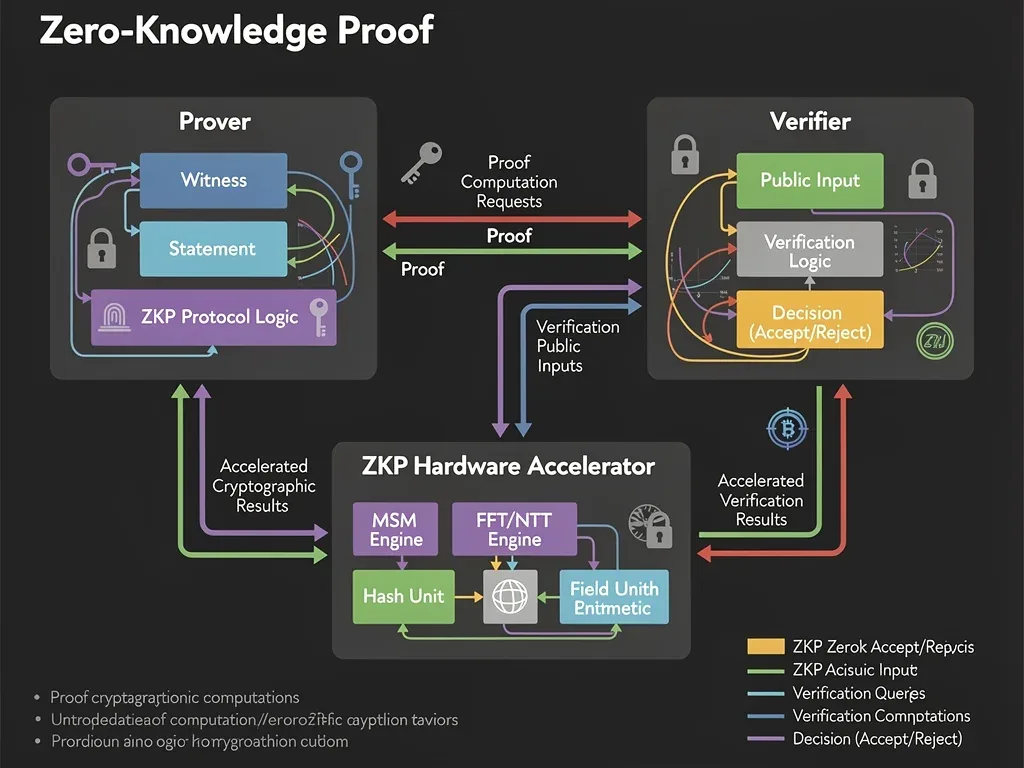
These accelerators are not just about raw speed; they also aim to improve energy efficiency. By performing ZKP computations more effectively, they can achieve the same results with significantly less power consumption compared to software-only solutions running on CPUs. This is particularly important for large-scale cloud deployments where energy costs and environmental impact are major considerations. The introduction of these specialized hardware units marks a significant milestone in the journey towards ubiquitous, privacy-preserving computation.
Speeding Up Cryptographic Verification by 12x
The most compelling benefit of Zero-Knowledge Hardware Accelerators is their ability to dramatically accelerate cryptographic verification. Early benchmarks and research indicate that these specialized units can speed up the verification process by a factor of 12x or even more compared to traditional CPU-based methods. This exponential leap in performance has profound implications for enterprise cloud systems, enabling applications that were previously impossible.
Imagine the impact of reducing a verification process from several minutes to mere seconds, or from seconds to milliseconds. This level of acceleration transforms ZKPs from a niche, computationally expensive tool into a practical, real-time solution for a wide array of enterprise needs. Such speed is critical for high-volume transactions, continuous data integrity checks, and instantaneous user authentication in distributed cloud environments.
Real-World Impact and Use Cases
The 12x speedup means that enterprises can now implement ZKP-based solutions without compromising on performance or user experience. This opens doors for innovative applications across various sectors:
- Financial Services: Faster, privacy-preserving settlement of transactions and regulatory compliance checks.
- Supply Chain Management: Real-time verification of product authenticity and origin without revealing proprietary data.\
- Healthcare: Secure sharing of patient data for research or diagnostics while maintaining strict privacy.\
- Decentralized Identity: Instantaneous verification of credentials without exposing personal information.
This acceleration is not merely about making existing processes faster; it's about fundamentally changing what's possible. Enterprises can now design cloud architectures that prioritize both security and performance, integrating ZKP capabilities into their core operations. The ability to perform complex cryptographic checks almost instantaneously eliminates a major barrier to the widespread adoption of advanced privacy-preserving technologies.
Moreover, the efficiency gains extend beyond just speed. By completing computations faster, these accelerators reduce the overall computational load and energy footprint. This means lower operational costs for cloud providers and more sustainable computing practices. The 12x speedup is a testament to the power of specialized hardware in addressing specific computational challenges, ushering in a new era of secure and efficient cloud computing.
Integration into Enterprise Cloud Systems
Integrating Zero-Knowledge Hardware Accelerators into existing enterprise cloud systems is a multi-faceted process that requires careful planning and execution. The goal is to seamlessly incorporate these specialized units into the cloud infrastructure, making their capabilities accessible to developers and applications without significant architectural overhaul. This involves both hardware deployment and software-level integration.
Cloud providers are exploring various models for deploying these accelerators. One common approach is to offer them as a service, similar to how GPUs are provided for machine learning workloads. This allows enterprises to leverage the benefits of ZKP acceleration on demand, without the need to invest in and manage their own hardware. This 'as-a-service' model promotes scalability and cost-effectiveness, making ZKP capabilities more accessible to a broader range of businesses.
Deployment Models and Challenges
The physical deployment of accelerators can involve dedicated server racks within data centers or integration directly into existing server units. Challenges include ensuring compatibility with current cloud operating systems, network infrastructure, and security protocols. Software integration is equally crucial, requiring robust APIs and SDKs that allow applications to easily offload ZKP computations to the accelerators.
- Cloud Integration: Seamless deployment within existing cloud infrastructure.
- API Development: User-friendly interfaces for developers to access accelerator functions.\
- Security Protocols: Ensuring secure communication between applications and accelerators.\
- Scalability: Designing systems that can scale accelerator resources based on demand.
Furthermore, cloud providers need to develop management tools that allow enterprises to monitor and optimize their ZKP workloads running on these accelerators. This includes performance metrics, resource utilization, and cost tracking. The aim is to make the use of ZKP accelerators as transparent and efficient as possible for the end-user, abstracting away the underlying hardware complexities.

Successful integration will ultimately depend on the collaboration between hardware manufacturers, cloud providers, and application developers. By creating a robust ecosystem, Zero-Knowledge Hardware Accelerators can become a standard component of enterprise cloud security architectures, driving innovation in privacy-preserving computation. The focus is on making these powerful tools readily available and easy to use, accelerating their adoption across industries.
Challenges and Future Outlook
While Zero-Knowledge Hardware Accelerators promise revolutionary advancements, their widespread adoption and full potential are not without challenges. The development of specialized hardware is an expensive and time-consuming endeavor, requiring significant investment in research, design, and manufacturing. Furthermore, the rapid evolution of ZKP algorithms means that hardware designs must be flexible enough to adapt to new cryptographic primitives and efficiency improvements.
One significant challenge lies in standardization. As various companies develop their own accelerator architectures, ensuring interoperability and common programming interfaces will be crucial for fostering a robust ecosystem. Without standardization, fragmentation could hinder widespread adoption and increase the complexity for developers and enterprises seeking to integrate these technologies into their diverse cloud environments.
Overcoming Hurdles and Paving the Way
The talent gap is another critical factor. Developing, deploying, and managing ZKP hardware accelerators requires specialized expertise in cryptography, hardware design, and cloud engineering. There is a pressing need for educational initiatives and training programs to cultivate a workforce capable of leveraging these advanced technologies effectively. Collaboration between academia and industry will be vital in addressing this.
- Cost of Development: High R&D and manufacturing expenses.
- Algorithm Evolution: Need for flexible and future-proof hardware designs.\
- Standardization: Ensuring interoperability across different vendor solutions.\
- Talent Gap: Shortage of skilled professionals in ZKP and hardware acceleration.
Despite these challenges, the future outlook for Zero-Knowledge Hardware Accelerators is incredibly promising. Continued advancements in semiconductor technology, coupled with growing demand for privacy-preserving computation, will drive further innovation in this space. We can expect to see more powerful, energy-efficient, and versatile accelerators emerging, capable of supporting an even broader range of ZKP schemes and applications.
The long-term vision includes a future where ZKP acceleration is a standard feature in every enterprise cloud system, enabling a new era of secure, private, and efficient digital interactions. As these technologies mature and become more accessible, they will unlock unprecedented opportunities for innovation in areas ranging from secure multi-party computation to fully homomorphic encryption, transforming the digital landscape as we know it.
The Transformative Power for Enterprise Security
The introduction of Zero-Knowledge Hardware Accelerators marks a pivotal moment for enterprise security. By enabling 12x faster cryptographic verification, these accelerators fundamentally enhance the security posture of cloud systems without compromising on performance. This transformative power extends beyond mere speed, impacting data privacy, compliance, and the overall trust framework of digital operations.
Enterprises can now deploy advanced cryptographic solutions that were previously deemed too slow or resource-intensive. This means better protection against data breaches, more robust authentication mechanisms, and the ability to conduct sensitive computations in the cloud with unprecedented levels of privacy. The ability to verify data and computations without revealing the underlying information addresses some of the most critical security concerns in today's interconnected world.
Building Trust in the Cloud
For many organizations, the perceived lack of control and transparency in cloud environments has been a significant barrier to adopting certain services. ZKPs, accelerated by dedicated hardware, can help bridge this trust gap. By allowing enterprises to cryptographically verify the integrity and correctness of cloud operations without exposing their proprietary data, they gain a higher degree of assurance and control.
- Enhanced Data Privacy: Verify without revealing sensitive information.
- Regulatory Compliance: Easier adherence to strict data protection laws like GDPR and HIPAA.\
- Reduced Attack Surface: Less data exposure means fewer opportunities for attackers.\
- Improved Auditability: Cryptographically verifiable proofs for compliance and internal audits.
The implications for compliance are particularly significant. With increasingly stringent data protection regulations worldwide, enterprises are under immense pressure to safeguard personal and proprietary information. Zero-Knowledge Hardware Accelerators provide a powerful tool to meet these requirements, enabling verifiable compliance without the need for complex, data-exposing audit processes. This streamlines regulatory adherence and reduces the risk of costly penalties.
Ultimately, the transformative power of these accelerators lies in their ability to foster a new era of trust in the cloud. By making privacy-preserving cryptography both fast and scalable, they empower enterprises to fully leverage the benefits of cloud computing while maintaining an uncompromising stance on security and data confidentiality. This innovation is not just an upgrade; it's a fundamental rethinking of how secure operations can and should be conducted in the digital age.
| Key Aspect | Brief Description |
|---|---|
| ZKP Definition | A cryptographic method to prove a statement's truth without revealing any underlying information. |
| Acceleration Need | ZKPs are computationally intensive, requiring specialized hardware for practical enterprise use. |
| Performance Boost | Hardware accelerators can speed up ZKP verification by up to 12x in enterprise cloud systems. |
| Cloud Integration | Seamlessly integrating accelerators as a service into existing cloud infrastructure is key for adoption. |
Frequently Asked Questions About ZKP Hardware Accelerators
What are Zero-Knowledge Hardware Accelerators?▼Zero-Knowledge Hardware Accelerators are specialized computing units designed to efficiently process the complex mathematical operations required for Zero-Knowledge Proofs (ZKPs). They offload these intensive cryptographic computations from general-purpose CPUs, significantly speeding up both proof generation and verification, making ZKPs practical for enterprise cloud applications.
How do they speed up cryptographic verification?▼These accelerators achieve speedups by leveraging highly parallel architectures and optimized instruction sets specifically tailored for ZKP algorithms. Unlike CPUs, which are general-purpose, accelerators like FPGAs and ASICs can execute the repetitive and complex cryptographic primitives much more efficiently, leading to performance gains of up to 12x or more.
What benefits do they offer for enterprise cloud systems?▼For enterprise cloud systems, ZKP hardware accelerators offer enhanced data privacy, improved security, and faster regulatory compliance. They enable real-time verification of sensitive data without exposure, reduce computational overhead, and allow for the deployment of advanced cryptographic solutions at scale, fostering greater trust in cloud operations.
Are Zero-Knowledge Hardware Accelerators widely available?▼While still an emerging technology, Zero-Knowledge Hardware Accelerators are gaining traction. Cloud providers are beginning to offer them as specialized services, similar to GPU instances, allowing enterprises to access their benefits on demand. As the technology matures and demand grows, their availability is expected to become more widespread in enterprise cloud environments.
What are the main challenges for their adoption?▼Key challenges for adoption include the high cost of development and manufacturing, the need for flexible hardware designs to adapt to evolving ZKP algorithms, the establishment of industry standards for interoperability, and addressing the current talent gap in specialized cryptography and hardware engineering expertise. Overcoming these will accelerate widespread use.
Conclusion
Zero-Knowledge Hardware Accelerators are not merely an incremental improvement but a foundational shift in how enterprise cloud systems will handle security and privacy. By accelerating cryptographic verification by up to 12x, these specialized units are transforming the theoretical promise of Zero-Knowledge Proofs into a tangible reality. This innovation empowers businesses to achieve unprecedented levels of data privacy, regulatory compliance, and operational efficiency, ultimately fostering a more secure and trustworthy digital ecosystem. As these technologies mature and become more integrated into cloud infrastructure, they will undoubtedly redefine the landscape of enterprise computing, paving the way for a future where robust security and high performance coexist seamlessly.
