6G Terahertz Wireless: Strategic Insights from 100-Gbps Trials
Advertisements

6G terahertz wireless prototypes are demonstrating unprecedented speeds in nationwide spectrum trials, achieving 100-Gbps, paving the way for revolutionary advancements in future connectivity and communication technologies.
Understanding the 6G Terahertz Frontier
The telecommunications landscape is on the cusp of its next major evolution with the advent of 6G. Unlike its predecessors, 6G aims to deliver not just faster speeds but a truly transformative connectivity experience. At the heart of this revolution are 6G terahertz wireless prototypes, pushing the boundaries of what's possible in data transmission. These prototypes are currently undergoing rigorous nationwide spectrum trials, showcasing capabilities that promise to redefine industries and daily life.
Terahertz (THz) frequencies, spanning from 0.1 THz to 10 THz, offer an expansive bandwidth far exceeding that of 5G's millimeter-wave spectrum. This vast spectral real estate is crucial for achieving the ultra-high data rates and ultra-low latencies envisioned for 6G. The trials are not merely about speed; they are about understanding the propagation characteristics, overcoming atmospheric absorption, and developing robust hardware and software solutions that can reliably operate in this challenging frequency band.
Early results from these trials, particularly those demonstrating 100-Gbps connections, are providing strategic insights into the practical implementation of 6G. These insights are critical for policymakers, industry leaders, and researchers alike, guiding the future development and deployment strategies for this next-generation wireless technology. The challenges are significant, but the potential rewards are even greater, promising a future where seamless, instantaneous connectivity is the norm.
The Promise of Terahertz Frequencies
Terahertz frequencies hold immense potential for future wireless communications due to their large available bandwidth. This enables unprecedented data rates, far beyond what current technologies can offer. However, their unique physical properties also present significant engineering hurdles.
- Massive Bandwidth: Terahertz waves can carry vast amounts of data, enabling multi-gigabit and even terabit-per-second connections.
- High Spatial Resolution: Shorter wavelengths allow for highly directional beams, improving spatial multiplexing and security.
- Integration Potential: Can be integrated with existing optical fiber networks, bridging the gap between wired and wireless.
- New Applications: Opens doors for advanced sensing, imaging, and ultra-fast short-range communications.
The strategic deployment of terahertz technology necessitates careful consideration of its propagation characteristics. Atmospheric conditions, such as humidity and rain, can significantly attenuate THz signals. Researchers are exploring various techniques, including advanced beamforming and intelligent reflective surfaces, to mitigate these effects and ensure reliable communication links.
100-Gbps Nationwide Spectrum Trials: A Closer Look
The current nationwide spectrum trials for 6G terahertz wireless prototypes are a critical phase in bringing this technology to fruition. These trials are not just about laboratory demonstrations; they involve real-world scenarios to assess performance, reliability, and feasibility across diverse environments. Achieving 100-Gbps speeds in these trials is a monumental step, validating the theoretical potential of terahertz frequencies and providing tangible evidence of their practical applicability.
These trials are meticulously designed to test various aspects of the 6G ecosystem. This includes evaluating different antenna designs, transceiver architectures, signal processing algorithms, and network protocols. The goal is to identify optimal configurations and methodologies that can support ultra-high data rates over varying distances and conditions. The data gathered from these trials is invaluable, informing the standardization efforts and regulatory frameworks that will shape the future of 6G.
Furthermore, the trials are fostering collaboration between academic institutions, private industry, and government bodies. This multidisciplinary approach is essential for tackling the complex technical challenges associated with terahertz communications. The insights gleaned from these collaborative efforts are accelerating innovation and ensuring that 6G development proceeds efficiently and effectively.
Key Aspects of the Trials
The nationwide trials encompass several critical areas to thoroughly evaluate 6G terahertz capabilities. This includes testing in different geographical locations and environmental conditions.
- Urban Environments: Assessing signal propagation in dense urban areas with obstructions.
- Rural Deployments: Evaluating coverage and reach in less populated regions.
- Indoor Scenarios: Testing performance within buildings and complex indoor spaces.
- Mobility Testing: Analyzing handover and connectivity for moving users and devices.
The focus on 100-Gbps speeds is particularly significant. It demonstrates that the vision of ultra-fast, low-latency communication is not just theoretical but achievable with current prototype technology. This benchmark sets a high bar for future commercial deployments and highlights the immense potential of 6G to enable applications that are currently unimaginable.
Technological Innovations Driving 6G Terahertz
The realization of 6G terahertz wireless prototypes achieving 100-Gbps speeds is a testament to significant technological innovations across multiple domains. From advanced materials to sophisticated signal processing, every component plays a crucial role. Miniaturization of components is also a key factor, allowing for the integration of complex systems into smaller form factors, which is essential for widespread deployment.
One of the most critical areas of innovation lies in transceiver design. Operating at terahertz frequencies requires new approaches to generate, transmit, and receive signals with high efficiency and low noise. This involves advancements in semiconductor technologies, such as Indium Phosphide (InP) and Gallium Nitride (GaN), which can operate at these extremely high frequencies. Furthermore, the development of highly directional antennas, including phased arrays and reconfigurable intelligent surfaces (RIS), is vital for overcoming the inherent challenges of THz propagation, such as high path loss and atmospheric absorption.
Beyond hardware, significant progress is being made in signal processing and coding schemes. New modulation techniques, such as orthogonal frequency-division multiplexing (OFDM) variants and advanced pulse shaping, are being explored to maximize spectral efficiency and robustness. Machine learning and artificial intelligence are also playing an increasingly important role, enabling dynamic spectrum management, intelligent beamforming, and predictive channel estimation, all of which are crucial for optimizing 6G network performance.
Advanced Antenna Systems
Advanced antenna systems are fundamental to unlocking the potential of terahertz communications. These systems must overcome significant signal attenuation and dispersion.
- Phased Arrays: Electronically steerable beams to focus energy and compensate for path loss.
- Reconfigurable Intelligent Surfaces (RIS): Passive surfaces that can intelligently reflect and refract THz waves, extending coverage.
- Massive MIMO for THz: Utilizing a large number of antenna elements to enhance spatial multiplexing and beamforming gains.
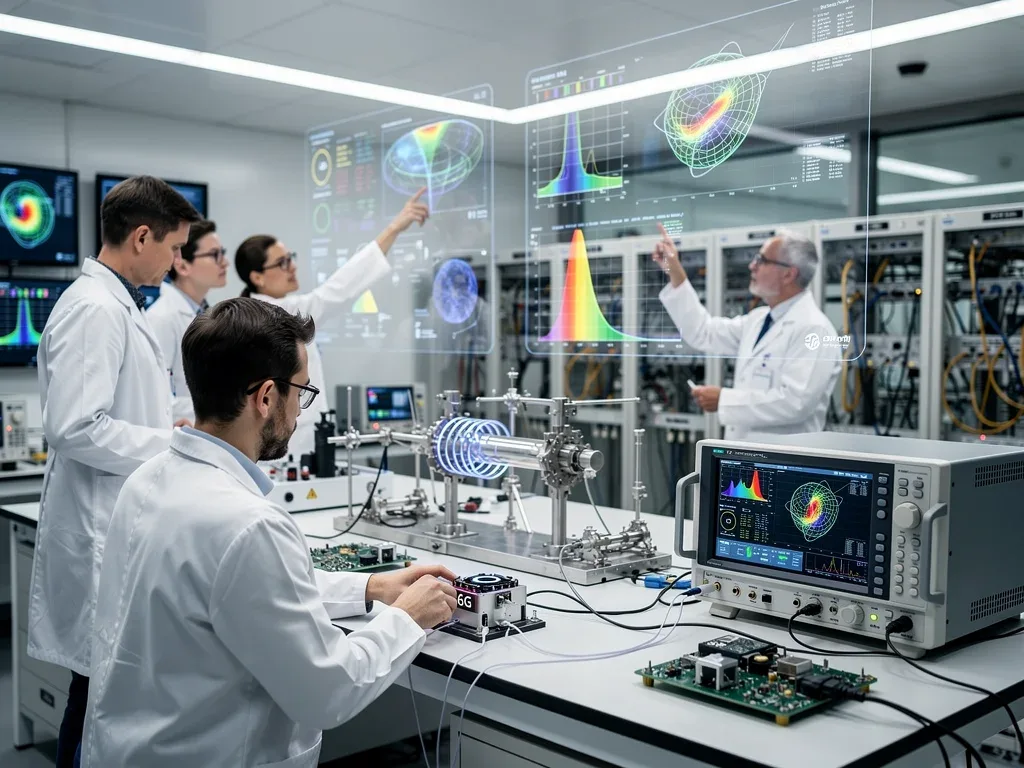
The integration of these advanced antenna systems with sophisticated control algorithms is what allows for the precise targeting of THz beams, ensuring reliable connectivity even in challenging environments. The ability to dynamically adjust beam directions and characteristics is essential for maintaining robust links as devices move and environmental conditions change.
Challenges and Opportunities in Terahertz Spectrum
While the promise of 6G terahertz wireless is immense, several significant challenges must be addressed for its widespread adoption. The unique properties of terahertz waves, while offering advantages, also present engineering hurdles that require innovative solutions. Understanding and mitigating these challenges are central to the strategic insights gained from current trials.
One of the primary challenges is the high atmospheric absorption of terahertz waves, particularly by water vapor. This leads to shorter propagation distances compared to lower frequency bands and necessitates smaller cell sizes and denser deployments. Developing robust link budgets and efficient power amplifiers that can operate effectively at these frequencies without excessive power consumption is also a major hurdle. Furthermore, the cost of manufacturing high-frequency components and the complexity of integrating them into consumer devices need to be carefully managed to ensure commercial viability.
Despite these challenges, the opportunities presented by the terahertz spectrum are transformative. Beyond ultra-fast communication, THz frequencies open doors to novel applications in sensing, imaging, and healthcare. Imagine highly accurate environmental monitoring, non-invasive medical diagnostics, and secure, high-bandwidth communication for critical infrastructure. The strategic insights from current trials are helping to prioritize research and development efforts, focusing on solutions that can overcome present limitations and unlock these future possibilities.
Overcoming Propagation Limitations
Mitigating the inherent propagation challenges of terahertz waves is crucial for reliable 6G services. Researchers are exploring various strategies to extend range and improve signal integrity.
- Advanced Materials: Developing new materials for low-loss waveguides and components.
- Relay Nodes and Repeaters: Deploying dense networks of small cells and intelligent repeaters to extend coverage.
- Channel Modeling: Accurate modeling of THz channels to predict and compensate for signal degradation.
- Dynamic Beamforming: Real-time adjustment of antenna beams to track users and optimize signal strength.
The ongoing trials are providing invaluable data on how these mitigation techniques perform in real-world conditions. This empirical evidence is essential for refining models and developing practical deployment strategies. The balance between performance, cost, and complexity is a key consideration in these efforts, aiming for solutions that are both effective and economically viable for future 6G networks.
Strategic Implications for Industries and Society
The successful development and deployment of 6G terahertz wireless prototypes, especially with 100-Gbps capabilities, will have profound strategic implications across various industries and for society at large. This isn't just an incremental improvement over 5G; it represents a paradigm shift in how we connect, interact, and innovate. The insights from current trials are already shaping expectations and investment decisions in sectors poised to benefit most from this ultra-fast, low-latency connectivity.
For industries like manufacturing, healthcare, and logistics, 6G will enable truly immersive and autonomous systems. Imagine factories where robots communicate instantaneously, performing complex tasks with unprecedented precision, or remote surgeries conducted with no perceptible delay. The massive data throughput will fuel advancements in artificial intelligence, virtual reality, and augmented reality, leading to hyper-personalized experiences and intelligent environments. Smart cities will become even smarter, with ubiquitous sensing and real-time data analysis optimizing everything from traffic flow to energy consumption.
From a societal perspective, 6G promises to bridge digital divides by providing high-speed internet access to underserved areas, fostering economic growth and educational opportunities. However, it also raises important questions about digital equity, cybersecurity, and data privacy, which need to be addressed proactively. The strategic insights from current trials are therefore not just technical; they also involve understanding the broader socio-economic impact and preparing for the ethical and regulatory challenges that will accompany this technological leap.
Transformative Industry Applications
The capabilities of 6G terahertz wireless will unlock a new era of industrial and commercial applications, driving innovation and efficiency.
- Immersive Extended Reality (XR): Ultra-low latency and high bandwidth for truly realistic VR/AR experiences.
- Holographic Communication: Real-time 3D holographic presence for remote collaboration and entertainment.
- Autonomous Systems: Enhanced connectivity for self-driving vehicles, drones, and robotics.
- Digital Twins: Real-time, highly accurate digital replicas of physical assets for simulation and optimization.

The strategic planning for 6G deployment must consider these diverse applications and their specific requirements. Different industries will demand different levels of reliability, latency, and throughput. The ongoing trials are instrumental in gathering data to inform these differentiated service offerings and ensure that 6G infrastructure can support the full spectrum of future innovation.
The Road Ahead: Standardization and Commercialization
The journey from 6G terahertz wireless prototypes to widespread commercialization is complex, involving significant efforts in standardization, regulatory alignment, and infrastructure development. The strategic insights gleaned from the ongoing 100-Gbps nationwide spectrum trials are crucial for navigating this path efficiently. These insights are not only validating technical feasibility but also informing the economic models and deployment strategies that will define 6G's commercial success.
Standardization bodies, such as the 3rd Generation Partnership Project (3GPP) and the International Telecommunication Union (ITU), are actively working on defining the specifications for 6G. The data from trials helps these bodies make informed decisions regarding frequency allocations, interface protocols, and performance requirements. International collaboration is paramount to ensure global interoperability and avoid fragmentation of the 6G ecosystem. Regulatory bodies also play a vital role in spectrum allocation and policy formulation, ensuring fair competition and the efficient use of precious terahertz resources.
Commercialization will depend on the development of cost-effective and energy-efficient hardware, as well as compelling use cases that justify the investment. Early deployment will likely target specific high-value applications and industrial environments before gradually expanding to broader consumer markets. The strategic insights from current trials are providing a clear roadmap, highlighting areas where further research and development are needed and identifying the most promising avenues for early adoption. The transition will be gradual, building upon the foundations laid by 5G, but with the distinct capabilities of terahertz technology leading the way.
Key Steps to Commercialization
Bringing 6G terahertz wireless to market requires a coordinated effort across various stakeholders, from research to deployment.
- Global Standardization: Establishing unified technical specifications and protocols for interoperability.
- Spectrum Allocation: Regulatory bodies assigning appropriate frequency bands for commercial use.
- Infrastructure Development: Building out dense networks of base stations and backhaul infrastructure.
- Component Miniaturization: Developing smaller, more power-efficient THz transceivers and antennas.
- Killer Applications: Identifying and developing compelling use cases that drive demand and investment.
The success of commercialization hinges on a delicate balance of technological readiness, economic viability, and regulatory support. The current trials are providing the foundational knowledge to address these aspects strategically, ensuring that 6G terahertz wireless can deliver on its promise of a truly connected and intelligent future.
| Key Aspect | Description |
|---|---|
| Terahertz Frequencies | Utilizes 0.1 THz to 10 THz for massive bandwidth and ultra-high data rates, a core enabler for 6G. |
| 100-Gbps Trials | Nationwide spectrum trials demonstrating unprecedented 100-Gbps speeds, validating 6G's potential. |
| Technological Innovations | Advances in transceivers, antenna systems (RIS, phased arrays), and AI-driven signal processing. |
| Strategic Implications | Transformative impact on industries like XR, autonomous systems, healthcare, and smart cities. |
Frequently Asked Questions about 6G Terahertz Wireless
What is 6G terahertz wireless technology?▼6G terahertz wireless technology refers to the next generation of cellular communication operating in the terahertz frequency band (0.1 THz to 10 THz). It aims to deliver significantly higher data rates, lower latency, and greater capacity than 5G, enabling new applications like holographic communication and advanced AI integration.
Why are terahertz frequencies important for 6G?▼Terahertz frequencies offer an enormous amount of unused bandwidth, which is crucial for achieving the ultra-high data speeds envisioned for 6G, such as 100-Gbps and beyond. This vast spectrum allows for the transmission of massive amounts of data simultaneously, supporting data-intensive applications.
What are the main challenges in developing 6G terahertz prototypes?▼Key challenges include high atmospheric absorption of THz waves, requiring short transmission distances; the need for advanced, efficient transceivers and antennas; and the complexity of signal processing at such high frequencies. Overcoming these requires significant material science and engineering innovation.
How do 100-Gbps nationwide spectrum trials contribute to 6G development?▼These trials provide crucial real-world data on the performance and reliability of 6G terahertz prototypes. They help validate theoretical models, identify practical implementation challenges, and inform standardization efforts, accelerating the transition from laboratory research to commercial deployment.
What strategic impact will 6G terahertz wireless have on society?▼6G will enable transformative applications across various sectors, including immersive extended reality, fully autonomous systems, and advanced healthcare. It will foster digital inclusion, drive economic growth, and create intelligent environments, fundamentally altering how we live, work, and interact.
Conclusion
The journey towards 6G is rapidly accelerating, with 6G terahertz wireless prototypes demonstrating remarkable capabilities in the latest 100-Gbps nationwide spectrum trials. These strategic insights confirm the immense potential of terahertz frequencies to revolutionize wireless communication, promising unprecedented speeds, ultra-low latency, and a foundation for truly intelligent and interconnected environments. While significant technical challenges remain, the collaborative efforts across academia, industry, and government are systematically addressing these hurdles, paving the way for global standardization and eventual commercialization. The transformative impact on industries, from immersive XR to autonomous systems, and on society as a whole, underscores the critical importance of these ongoing developments. As we move closer to a 6G-enabled future, the strategic insights from these trials will continue to guide the evolution of a technology set to redefine our digital world.
