Next-Gen AI Agents: Automate 40% Workflow Operations with Multi-Model Orchestration
Advertisements

Next-generation AI agents, powered by multi-model orchestration, are poised to revolutionize business operations by automating complex workflows, offering a strategic blueprint to achieve up to 40% operational efficiency gains.
The landscape of business operations is undergoing a profound transformation, with next-generation AI agents at the forefront. This article delves into a step-by-step blueprint to leverage AI agents workflow automation through multi-model orchestration, aiming to automate a significant 40% of your operational workflows and unlock unprecedented efficiency.
Understanding Next-Gen AI Agents and Multi-Model Orchestration
Next-generation AI agents represent a significant leap beyond traditional automation tools. Unlike simple scripts or rule-based bots, these agents are endowed with advanced cognitive capabilities, enabling them to understand context, make decisions, learn from experience, and adapt to dynamic environments. They are designed to operate autonomously, often collaborating with other agents or human counterparts to achieve complex objectives. Their intelligence is derived from sophisticated AI models, encompassing natural language processing (NLP), computer vision, machine learning, and more.
The true power of these agents is unleashed through multi-model orchestration. This concept refers to the seamless integration and coordinated management of diverse AI models, each specialized in a particular task or data type. Instead of relying on a single, monolithic AI, multi-model orchestration allows for a flexible and robust system where different AI components work in harmony. For instance, an NLP model might interpret customer queries, while a computer vision model processes visual data, and a predictive analytics model forecasts demand. An orchestrator then intelligently routes information, assigns tasks, and ensures smooth communication between these models, creating a powerful, cohesive AI system capable of tackling multifaceted business challenges.
This integrated approach addresses the limitations of single-model AI, which often struggles with tasks requiring diverse cognitive abilities. By combining specialized models, multi-model orchestration allows AI agents to handle more complex, end-to-end processes, bridging the gaps between different data types and analytical requirements. This foundational understanding is crucial for any organization looking to implement advanced AI solutions and achieve substantial workflow automation.
Identifying Key Workflows for Automation Potential
Before embarking on an automation journey, a critical first step is to thoroughly identify and analyze existing workflows within your organization. Not all workflows are created equal when it comes to AI automation potential. The goal is to pinpoint processes that are repetitive, high-volume, time-consuming, prone to human error, or involve multiple disparate systems. These are the low-hanging fruit where AI agents can deliver the most immediate and significant impact, contributing to the ambitious goal of automating 40% of operations.
Analyzing Current Processes
- Process Mapping: Document every step of a workflow, including inputs, outputs, decision points, and involved stakeholders.
- Bottleneck Identification: Pinpoint areas where delays or inefficiencies frequently occur, as these often indicate opportunities for AI intervention.
- Data Availability: Assess the quality and accessibility of data required for AI models. AI agents thrive on structured and semi-structured data.
Consider areas such as customer service (e.g., query routing, FAQ responses), data entry and processing (e.g., invoice processing, document analysis), IT operations (e.g., incident management, basic troubleshooting), and HR tasks (e.g., onboarding, basic inquiry handling). These often involve predictable patterns and large volumes of data, making them ideal candidates for AI agent deployment. A comprehensive analysis will reveal not only where automation is possible but also where it will yield the greatest return on investment, guiding your strategic implementation efforts effectively.
Once potential workflows are identified, prioritize them based on their complexity, impact on business objectives, and ease of implementation. Starting with simpler, high-impact processes can build momentum and demonstrate early successes, fostering internal buy-in for broader AI adoption. This methodical approach ensures that resources are allocated efficiently and that the automation efforts align with overall business strategy.
Designing the Multi-Model Orchestration Architecture
The success of advanced AI automation hinges on a well-designed multi-model orchestration architecture. This involves selecting the right AI models, defining their interactions, and establishing a robust framework for data flow and task execution. The architecture must be scalable, flexible, and capable of handling various data types and operational complexities. Think of it as building a sophisticated central nervous system for your automated workflows, where each AI model acts as a specialized organ, and the orchestrator is the brain, coordinating all functions.
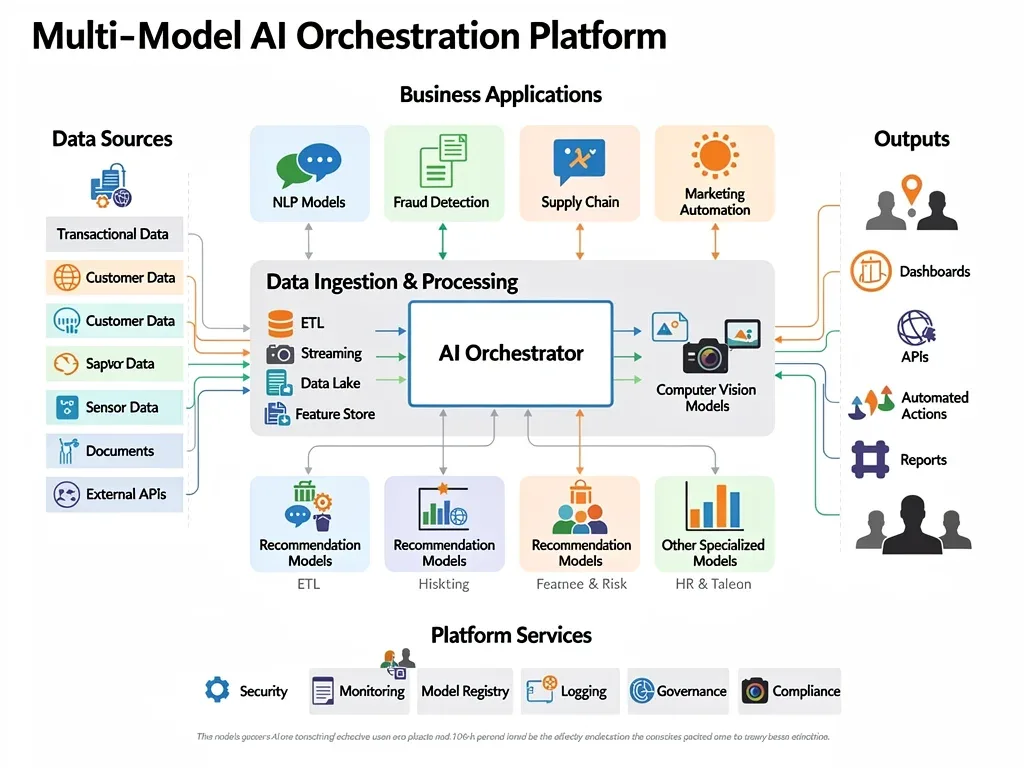
At the core of this architecture is the orchestrator itself. This central component is responsible for task assignment, data routing, error handling, and ensuring that the various AI models communicate effectively. It acts as the intelligent hub, receiving inputs, breaking down complex problems into smaller, manageable tasks for individual AI models, and then synthesizing their outputs into a coherent solution. For instance, in a customer support scenario, the orchestrator might first route a customer query to an NLP model for intent recognition, then to a knowledge base AI for information retrieval, and finally to a generative AI for crafting a personalized response.
Key Architectural Components
- Specialized AI Models: Integrate models for NLP, computer vision, speech recognition, predictive analytics, and more, based on workflow needs.
- Data Integration Layer: Ensure seamless connectivity with existing enterprise systems (CRMs, ERPs, databases) to feed data to AI models and receive outputs.
- Orchestration Engine: Develop or select a platform capable of managing task dependencies, scheduling, and dynamic routing between models.
- Monitoring and Analytics: Implement tools to track agent performance, identify bottlenecks, and gather insights for continuous improvement.
The choice of AI models will depend heavily on the specific tasks identified for automation. For document processing, a combination of OCR (Optical Character Recognition) and NLP models would be essential. For quality control in manufacturing, computer vision models would be paramount. The orchestrator's role is to abstract away the complexity of managing these diverse models, presenting a unified interface for defining and monitoring automated workflows. A well-thought-out architecture not only facilitates current automation efforts but also lays the groundwork for future expansion and the integration of even more advanced AI capabilities, making your system future-proof.
Developing and Training AI Agents
Once the architecture is in place, the next crucial phase involves the development and rigorous training of your AI agents. This is where the theoretical blueprint begins to take tangible form. Developing AI agents means configuring and customizing the chosen AI models to perform their specific tasks within the orchestrated workflow. This often involves fine-tuning pre-trained models with domain-specific data, ensuring they understand the nuances of your business processes and terminology. The quality of your data and the methodologies used for training directly impact the effectiveness and reliability of your AI agents.
Data preparation is a cornerstone of effective AI agent training. This includes collecting, cleaning, labeling, and transforming data into a format suitable for machine learning algorithms. High-quality, diverse datasets are essential for preventing bias and ensuring that agents can generalize well to new, unseen data. For example, an NLP agent trained on customer service tickets will perform better if its training data accurately reflects the variety of customer inquiries it will encounter in real-world scenarios. Iterative training, where models are repeatedly exposed to data and their performance is evaluated and refined, is key to achieving optimal results.
Training Methodologies
- Supervised Learning: Using labeled datasets to teach agents to recognize patterns and make predictions.
- Reinforcement Learning: Agents learn through trial and error, receiving rewards for desired actions and penalties for undesirable ones.
- Transfer Learning: Leveraging pre-trained models and fine-tuning them with smaller, specific datasets to accelerate development.
Beyond individual model training, it's vital to train the entire orchestrated system. This involves simulating end-to-end workflows and evaluating how different AI models interact and contribute to the overall outcome. This holistic testing helps identify integration issues, communication breakdowns, or instances where one model's output negatively impacts another. Continuous feedback loops, incorporating human oversight and expert input, are invaluable during this phase to progressively enhance the agents' accuracy and efficiency. The goal is to create agents that are not only proficient in their individual tasks but also operate seamlessly as part of a larger, intelligent system.
Implementing and Integrating Automated Workflows
With AI agents developed and trained, the next critical step is their strategic implementation and integration into your existing operational infrastructure. This phase moves beyond theoretical design and testing, bringing the automated workflows to life within your business environment. Successful implementation requires careful planning, robust technical execution, and close collaboration between AI specialists, IT teams, and business stakeholders. The aim is to seamlessly weave the AI-powered automation into daily operations without disrupting critical functions, while actively working towards the 40% automation target.
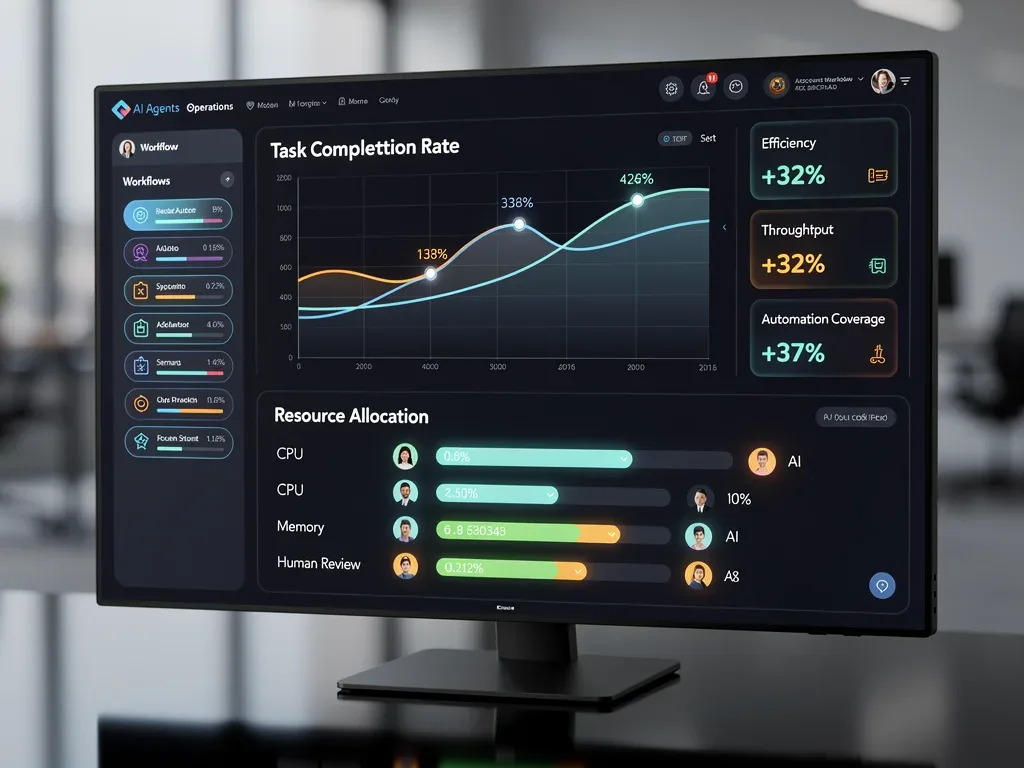
Integration involves connecting the AI orchestration platform with various enterprise systems, including CRM, ERP, HR platforms, and legacy databases. This ensures that AI agents have access to the necessary data inputs and can deliver their outputs to the correct destinations. APIs (Application Programming Interfaces) play a crucial role here, providing standardized communication channels between disparate systems. It's not just about technical connectivity; it's also about establishing data governance and security protocols to protect sensitive information processed by the AI agents. A well-integrated system ensures data consistency and reliability across the entire automated workflow.
Integration Best Practices
- Phased Rollout: Implement automated workflows incrementally, starting with less critical processes to minimize risk and gather feedback.
- API-First Approach: Prioritize using robust APIs for system integration to ensure scalability and maintainability.
- Security and Compliance: Embed data privacy, security, and regulatory compliance into every layer of the integration process.
- User Training and Adoption: Prepare human teams for new ways of working, providing training on how to interact with and leverage AI agents.
Post-implementation, continuous monitoring and optimization are paramount. Establish clear key performance indicators (KPIs) to measure the impact of automation, such as reduced processing time, decreased error rates, and cost savings. Collect feedback from users and stakeholders to identify areas for improvement and fine-tune agent behavior. This iterative process of deployment, monitoring, and refinement ensures that the automated workflows not only meet but exceed initial expectations, progressively contributing to the overall goal of significant operational automation. The ultimate objective is to create a symbiotic relationship where AI agents augment human capabilities, leading to greater efficiency and innovation.
Monitoring, Optimization, and Scalability
The journey of AI agents workflow automation does not end with implementation; it merely begins a continuous cycle of monitoring, optimization, and scaling. To realize the full 40% automation potential and beyond, organizations must establish robust mechanisms for observing agent performance, identifying areas for improvement, and expanding their capabilities across more workflows. This continuous feedback loop ensures that AI agents remain effective, adaptive, and aligned with evolving business needs, delivering sustained value over time.
Effective monitoring involves tracking a range of metrics, including task completion rates, accuracy levels, processing times, resource utilization, and error frequencies. Advanced analytics dashboards can provide real-time insights into the health and performance of the AI ecosystem. By proactively identifying deviations from expected behavior or emerging bottlenecks, teams can quickly intervene to diagnose and resolve issues. For example, if an NLP agent consistently misinterprets a certain type of customer query, this indicates a need for further training data or model refinement. This proactive approach minimizes downtime and maintains the integrity of automated processes.
Strategies for Continuous Improvement
- Performance Analytics: Utilize dashboards and reports to visualize agent performance metrics and identify trends.
- A/B Testing: Experiment with different AI model configurations or orchestration logic to find the most efficient approaches.
- Feedback Loops: Implement mechanisms for human users to provide feedback directly to AI agents, facilitating learning and adaptation.
Optimization is an ongoing process that leverages insights from monitoring to enhance agent efficiency and effectiveness. This might involve retraining models with updated data, adjusting orchestration rules, integrating new specialized AI models, or refining existing ones. The goal is to incrementally improve accuracy, reduce operational costs, and expand the scope of automation. As agents become more proficient and reliable, organizations can confidently scale their deployment to encompass a wider array of workflows, gradually increasing the percentage of automated operations. Scalability also means ensuring the underlying infrastructure can support growing computational demands, allowing for seamless expansion without performance degradation. This commitment to continuous improvement ensures that the initial investment in AI agents yields long-term, compounding benefits for the organization.
Overcoming Challenges and Ensuring Ethical AI Deployment
While the promise of automating 40% of workflows with next-gen AI agents is compelling, organizations must also be prepared to navigate a series of challenges and uphold ethical considerations. Technical hurdles, resistance to change, and the imperative for responsible AI deployment are significant factors that can impact the success and sustainability of automation initiatives. Addressing these proactively is crucial for building trust, ensuring long-term viability, and maximizing the benefits derived from AI investments.
One of the primary challenges lies in data quality and availability. AI agents are only as good as the data they are trained on. Inaccurate, incomplete, or biased data can lead to flawed decision-making and perpetuate existing organizational biases. Therefore, robust data governance strategies, including data cleaning, validation, and ethical data sourcing, are non-negotiable. Another common hurdle is the complexity of integrating AI solutions with legacy systems. Many enterprises operate with outdated infrastructure, making seamless API-driven integration a significant engineering task. Investing in modern integration platforms and potentially modernizing core systems can alleviate this.
Ethical AI Considerations
- Bias Detection and Mitigation: Regularly audit AI models for algorithmic bias and implement strategies to ensure fair and equitable outcomes.
- Transparency and Explainability: Strive for 'explainable AI' where the decision-making process of agents can be understood and audited.
- Data Privacy and Security: Adhere strictly to data protection regulations (e.g., GDPR, CCPA) and implement robust cybersecurity measures.
- Human Oversight and Accountability: Define clear lines of responsibility for AI agent actions and maintain human-in-the-loop mechanisms.
Beyond technical aspects, managing the human element is paramount. Employees may fear job displacement, leading to resistance. Transparent communication, reskilling initiatives, and demonstrating how AI augments human capabilities rather than replaces them can foster a positive attitude towards automation. Furthermore, ensuring ethical AI deployment is not just a regulatory requirement but a moral imperative. Organizations must establish clear ethical guidelines, conduct regular impact assessments, and prioritize fairness, accountability, and transparency in all AI agent operations. By proactively addressing these challenges and embedding ethical principles, businesses can build a resilient, trustworthy, and highly efficient AI-powered future.
| Key Aspect | Brief Description |
|---|---|
| Next-Gen AI Agents | Advanced AI with cognitive capabilities for autonomous decision-making and adaptation. |
| Multi-Model Orchestration | Coordinated management of diverse AI models for complex, end-to-end workflow automation. |
| 40% Workflow Automation | Strategic goal to achieve significant operational efficiency and productivity gains. |
| Ethical AI Deployment | Ensuring fairness, transparency, and accountability in all AI agent operations. |
Frequently Asked Questions about AI Agents and Workflow Automation
What are next-gen AI agents?▼Next-gen AI agents are advanced software entities equipped with cognitive abilities to understand context, make decisions, learn, and adapt autonomously. They go beyond simple rule-based automation, performing complex tasks and often collaborating to achieve business objectives efficiently.
How does multi-model orchestration enhance AI automation?▼Multi-model orchestration integrates diverse AI models (e.g., NLP, computer vision) to work together seamlessly. This allows AI agents to tackle multifaceted tasks that a single model cannot, improving accuracy, robustness, and the ability to automate complex, end-to-end workflows more effectively.
What types of workflows are best suited for AI agent automation?▼Workflows that are repetitive, high-volume, time-consuming, prone to human error, or involve multiple disparate systems are ideal. Examples include customer service inquiries, data entry, invoice processing, basic IT support, and HR onboarding tasks, where AI can deliver significant efficiency gains.
What are the key challenges in deploying AI agents for workflow automation?▼Key challenges include ensuring high-quality, unbiased data, integrating AI with legacy systems, managing employee resistance to change, and adhering to strict ethical guidelines for fairness, transparency, and data privacy. Addressing these is vital for successful implementation.
How can organizations ensure ethical AI deployment?▼Ethical deployment requires proactive bias detection and mitigation, fostering transparency and explainability in AI decisions, robust data privacy and security measures, and maintaining human oversight and accountability. Clear ethical guidelines must be established and consistently followed.
Conclusion
The strategic adoption of next-generation AI agents, powered by sophisticated multi-model orchestration, presents an unparalleled opportunity for businesses to achieve significant operational transformation. By following a structured blueprint from identifying suitable workflows to continuous monitoring and ethical deployment, organizations can realistically aim to automate up to 40% of their operations. This not only promises substantial gains in efficiency and cost reduction but also frees human talent to focus on more creative and strategic endeavors, fostering innovation and driving competitive advantage in an increasingly digital world. The future of work is undeniably interwoven with intelligent automation, and embracing this evolution is key to sustained success.
