Generative Drug Discovery Innovations: Cutting Clinical Trials by 35%
Advertisements

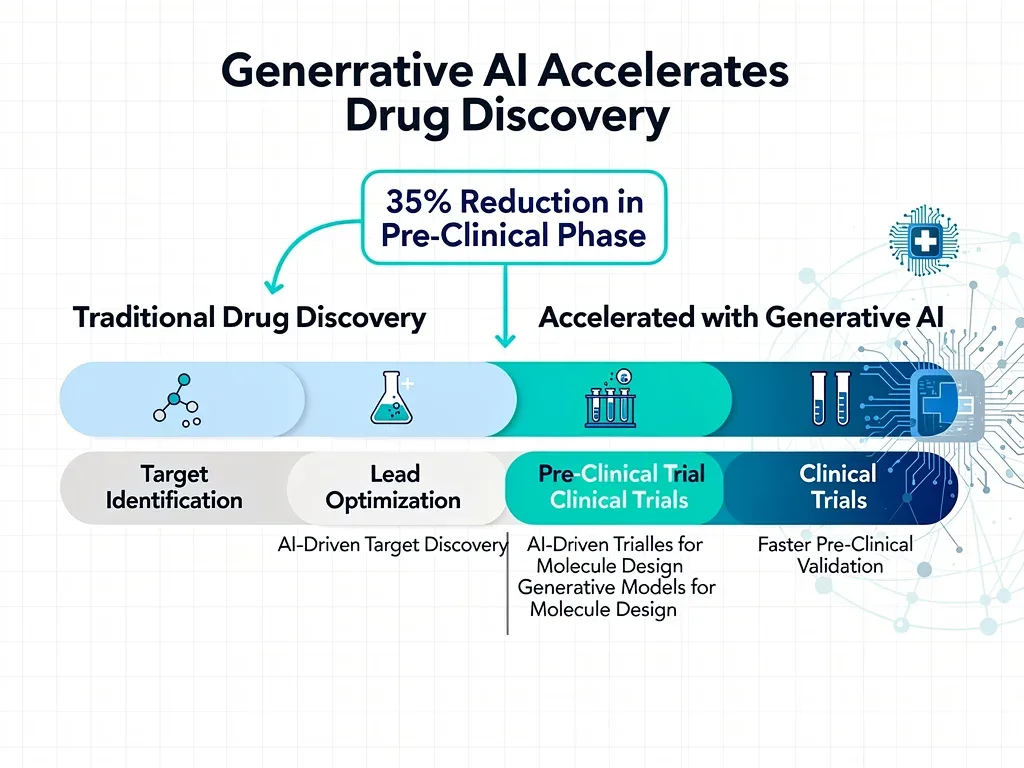
Generative drug discovery innovations, powered by advanced computational platforms, are dramatically accelerating pharmaceutical development, reducing clinical trial pre-phases by up to 35% and ushering in a new era of efficient and targeted medicine.
The pharmaceutical industry stands on the cusp of a revolution, driven by unprecedented technological advancements. Imagine a world where the arduous journey of bringing a new drug to market is significantly shortened, where life-saving treatments reach patients faster than ever before. This is the promise of generative drug discovery innovations, a paradigm shift powered by sophisticated computational platforms. These groundbreaking tools are not just optimizing existing processes; they are fundamentally transforming how we identify, design, and develop new therapeutic compounds, leading to a remarkable reduction in the pre-clinical trial phases. This article delves into how these innovations are reshaping the landscape of drug development and what it means for the future of healthcare.
The Dawn of Generative AI in Pharmaceutical Research
Generative artificial intelligence (AI) is rapidly becoming a cornerstone of modern pharmaceutical research, moving beyond traditional methods that often rely on serendipity and extensive, costly experimentation. This new era leverages AI to design novel molecules with desired properties from scratch, fundamentally altering the initial stages of drug development. The ability to predict molecular interactions and synthesize new chemical entities computationally is a game-changer.
Historically, drug discovery was a labor-intensive process, characterized by trial-and-error approaches and a high attrition rate. Researchers would screen vast libraries of compounds, hoping to find a handful with therapeutic potential. Generative AI flips this model, enabling scientists to conceptualize and virtually test millions of potential molecules in a fraction of the time, significantly enhancing the probability of success even before laboratory synthesis begins.
Redefining Molecular Design
At its core, generative AI excels at creating new data points that resemble a given training set. In drug discovery, this means designing molecules that adhere to specific criteria, such as binding affinity to a target protein, solubility, or metabolic stability. This capability dramatically streamlines the lead identification and optimization phases.
- De novo design: AI models generate entirely new molecular structures.
- Property prediction: Algorithms forecast key physicochemical and biological properties.
- Synthetic accessibility: Models can ensure generated molecules are chemically feasible to synthesize.
- Optimized lead compounds: Iterative design refines structures for enhanced efficacy and safety.
The impact of this redefined molecular design is profound. It allows researchers to explore a much broader chemical space than previously possible, uncovering innovative solutions that might have been overlooked through conventional means. This computational foresight is a crucial factor in accelerating the pre-clinical phases of drug development.
Computational Platforms: The Engine of Accelerated Discovery
Computational platforms are the indispensable infrastructure supporting generative drug discovery innovations. These platforms integrate advanced algorithms, extensive chemical databases, and high-performance computing to create a seamless environment for virtual drug development. They provide the tools necessary to analyze vast datasets, simulate complex biological processes, and generate novel molecular candidates.
The power of these platforms lies in their ability to process and learn from immense quantities of data – from genomic sequences and protein structures to existing drug properties and clinical trial outcomes. This data-driven approach allows AI models to identify subtle patterns and make informed predictions that human researchers alone would find challenging, if not impossible, to discern.
Key Features of Modern Platforms
Leading computational platforms for drug discovery are characterized by several critical functionalities. These include robust data management systems, sophisticated machine learning frameworks, and intuitive user interfaces that enable biologists and chemists to interact effectively with complex AI models without needing deep programming expertise.
- Data integration: Aggregating diverse datasets from various sources.
- Machine learning pipelines: Automated workflows for model training and prediction.
- Molecular simulation: Advanced tools for predicting molecular dynamics and interactions.
- Virtual screening: Rapid assessment of millions of compounds against specific targets.
By centralizing these capabilities, computational platforms create a synergistic environment where hypothesis generation, experimental design, and data analysis are tightly integrated. This holistic approach significantly reduces the time and resources traditionally required to move a drug candidate from concept to pre-clinical testing, directly contributing to the reported 35% reduction in pre-phase clinical trials.
Cutting Clinical Trial Pre-Phases by 35%: A Deep Dive
The claim of cutting clinical trial pre-phases by 35% with generative drug discovery innovations is not merely an ambitious target; it reflects a tangible shift in how pharmaceutical pipelines are managed. This significant reduction is achieved through several synergistic mechanisms, primarily by enhancing the efficiency and success rate of early-stage research and development.
Traditional pre-clinical phases involve extensive lead identification, lead optimization, and pre-clinical testing. Each step is time-consuming and often requires iterative cycles of synthesis and biological evaluation. Generative AI and computational platforms streamline these processes by providing better starting points, predicting potential issues earlier, and optimizing compounds more effectively.
Impact on Lead Identification and Optimization
One of the most profound impacts is seen in the lead identification and optimization stages. Instead of painstakingly synthesizing and testing thousands of compounds, AI can rapidly generate and filter millions of virtual molecules, prioritizing those with the highest probability of success. This drastically reduces the number of compounds that need to be physically synthesized and tested.
- Reduced screening time: Virtual screening replaces much of the physical high-throughput screening.
- Higher quality leads: AI-designed molecules often have optimized properties from the outset.
- Fewer optimization cycles: Iterative design in silico minimizes laboratory iterations.
- Early toxicity prediction: AI can flag potential toxicities before synthesis, saving resources.
The ability to predict efficacy and toxicity profiles with greater accuracy and speed means that drug candidates entering animal studies are already highly refined, leading to fewer failures and a faster progression through the pre-clinical pipeline. This predictive power is a cornerstone of the 35% reduction.

Overcoming Challenges in Drug Development with AI
Despite the immense promise, the journey of drug development has always been fraught with challenges. High costs, lengthy timelines, and a staggering failure rate have historically plagued the industry. Generative drug discovery innovations offer potent solutions to many of these long-standing obstacles, providing a more intelligent and efficient pathway to new therapies.
One of the most significant hurdles is the 'valley of death' – the gap between promising early research and successful clinical development. Many compounds fail in late-stage clinical trials due to unforeseen toxicity or lack of efficacy, leading to colossal financial losses and wasted effort. AI helps bridge this gap by improving the quality of drug candidates much earlier in the process.
Addressing High Attrition Rates
The attrition rate in drug development is notoriously high, with only a small fraction of compounds entering pre-clinical development ever making it to market. Generative AI directly tackles this issue by enhancing the predictive power at every stage, from target identification to lead optimization.
- Improved target validation: AI identifies and prioritizes the most promising biological targets.
- Enhanced compound design: Molecules are designed with a higher likelihood of success.
- Early identification of liabilities: Potential side effects are predicted before costly experiments.
- Personalized medicine insights: AI helps design drugs for specific patient populations.
By leveraging AI, pharmaceutical companies can make more informed decisions, reducing the number of costly failures in later stages. This strategic advantage translates directly into accelerated timelines and more efficient resource allocation, solidifying the impact of computational platforms.
Case Studies and Real-World Impact
The theoretical benefits of generative drug discovery innovations are increasingly being validated by real-world applications and compelling case studies. Numerous pharmaceutical companies and biotech startups are now leveraging these computational platforms to bring novel compounds to the cusp of clinical trials at an unprecedented pace. These examples underscore the tangible impact of AI on the drug development timeline and success rates.
From identifying new antibiotics to designing targeted cancer therapies, the versatility of generative AI is proving to be a powerful asset across various therapeutic areas. These successes are not just anecdotal; they represent a fundamental shift in how the industry approaches drug discovery, providing concrete evidence for the reported reduction in pre-clinical phases.
Pioneering Companies and Breakthroughs
Several companies are at the forefront of this revolution, demonstrating the practical efficacy of AI-driven drug discovery. Their pipelines are filling with promising candidates that have moved from concept to pre-clinical testing in record time, showcasing the transformative potential of these technologies.
- Atomwise: Utilized AI to identify novel drug candidates for various diseases, including Ebola.
- Insilico Medicine: Designed a novel drug for fibrosis that entered clinical trials within 18 months.
- Exscientia: Developed a molecule for obsessive-compulsive disorder that reached human trials in just 12 months.
- Recursion Pharmaceuticals: Employs AI to map disease biology and accelerate drug target identification.
These examples highlight how generative AI is not just an academic concept but a practical tool delivering measurable results. The ability to compress years of traditional research into months or even weeks is a testament to the power of these computational platforms and their role in cutting clinical trial pre-phases.
The Future Landscape of Pharmaceutical Development
The integration of generative drug discovery innovations and advanced computational platforms is not just a fleeting trend; it represents a fundamental reshaping of the pharmaceutical development landscape. Looking ahead, we can anticipate a future where drug discovery is more predictable, efficient, and ultimately, more successful in delivering life-changing medicines to patients. The trajectory is clear: AI will continue to play an increasingly central role, pushing the boundaries of what's possible.
This evolving landscape will likely see a greater emphasis on personalized medicine, where drugs are tailored to individual genetic profiles, and a proactive approach to disease prevention. The ability of AI to analyze vast biological and clinical data will unlock new insights into disease mechanisms, leading to more targeted and effective interventions.
Emerging Trends and Predictions
The rapid evolution of AI and computing power suggests several exciting trends for the future of pharmaceutical development. These include the rise of digital twins, enhanced integration of multi-omics data, and the continuous refinement of generative models to design even more complex and precise therapies.
- Digital twins: Creating virtual representations of patients for personalized drug testing.
- Multi-omics integration: Combining genomics, proteomics, and metabolomics for holistic insights.
- Quantum computing: Potential to further accelerate complex molecular simulations.
- Autonomous labs: AI-driven robots performing experiments based on computational predictions.
These emerging trends indicate a future where the drug discovery process is not only faster but also more intelligent and adaptive. The initial 35% reduction in pre-clinical trial phases is likely just the beginning, with further efficiencies and breakthroughs expected as these technologies mature and become more widely adopted across the industry.
Ethical Considerations and Regulatory Frameworks
As generative drug discovery innovations continue to advance, it becomes imperative to address the associated ethical considerations and develop robust regulatory frameworks. The power of AI to design potent new molecules raises questions about safety, intellectual property, and equitable access to these rapidly developed treatments. Ensuring responsible innovation is paramount to harnessing the full potential of these technologies for global health.
The rapid pace of technological change often outstrips the development of regulatory guidelines. Therefore, proactive engagement between innovators, regulators, and ethicists is crucial to establish standards that foster innovation while safeguarding public health and promoting ethical practices in drug development.
Navigating the New Frontier
The ethical landscape of AI-driven drug discovery is complex, touching upon issues of data privacy, algorithmic bias, and the potential for misuse of generative capabilities. Establishing clear guidelines and fostering transparency will be key to building public trust and ensuring responsible deployment.
- Data privacy: Protecting sensitive patient and research data used in AI models.
- Algorithmic bias: Ensuring AI models do not perpetuate or introduce biases in drug design.
- Intellectual property: Defining ownership of AI-generated molecular structures.
- Regulatory adaptation: Updating approval processes to accommodate AI-driven development.
Addressing these challenges requires a collaborative approach, involving interdisciplinary experts from science, ethics, law, and policy. By proactively tackling these considerations, the pharmaceutical industry can ensure that the benefits of generative AI are realized responsibly, ultimately leading to safer, more effective, and more accessible medicines for all.
| Key Aspect | Brief Description |
|---|---|
| Generative AI Core | AI designs novel molecules with desired properties, accelerating lead identification. |
| Computational Platforms | Integrate AI, data, and computing for virtual drug development and simulation. |
| Pre-Phase Reduction | Achieves a 35% cut in pre-clinical trial phases by optimizing early R&D. |
| Real-World Impact | Companies like Insilico Medicine demonstrate rapid progression to clinical trials. |
Frequently Asked Questions About Generative Drug Discovery
What are generative drug discovery innovations?▼Generative drug discovery innovations involve using artificial intelligence to design new molecules with specific therapeutic properties from scratch. These AI models learn from vast datasets to predict optimal structures and behaviors, significantly speeding up the initial stages of drug development compared to traditional methods.
How do computational platforms contribute to this acceleration?▼Computational platforms provide the essential infrastructure, integrating AI algorithms, large chemical databases, and high-performance computing. They enable virtual screening, molecular simulation, and data analysis, allowing researchers to rapidly identify, optimize, and test potential drug candidates in silico before laboratory synthesis.
What does a 35% reduction in clinical trial pre-phases mean?▼A 35% reduction signifies a substantial decrease in the time and resources required for lead identification, optimization, and pre-clinical testing. This acceleration means promising drug candidates reach human clinical trials much faster, potentially bringing life-saving treatments to patients years earlier than previously possible.
Are there real-world examples of this technology in action?▼Yes, companies like Insilico Medicine and Exscientia have successfully used generative AI to advance drug candidates into clinical trials in record time. These cases demonstrate the practical efficacy of AI in accelerating the drug discovery pipeline and delivering tangible results in pharmaceutical development.
What ethical considerations are important for generative drug discovery?▼Key ethical considerations include ensuring data privacy for training models, addressing potential algorithmic biases in drug design, defining intellectual property for AI-generated compounds, and adapting regulatory frameworks to keep pace with rapid technological advancements. Responsible innovation is crucial for public trust and safety.
Conclusion
The advent of generative drug discovery innovations, underpinned by sophisticated computational platforms, marks a transformative epoch in pharmaceutical research. The remarkable ability to cut clinical trial pre-phases by an impressive 35% is not merely an incremental improvement; it is a fundamental re-engineering of how new medicines are brought to fruition. By leveraging AI to design, predict, and optimize molecular compounds with unprecedented speed and accuracy, the industry is overcoming long-standing challenges of cost, time, and high failure rates. This paradigm shift promises a future where life-saving treatments are developed more efficiently, reach patients faster, and are potentially more personalized, ultimately ushering in a new era of healthcare innovation and human well-being.
