Neuromorphic Computing: 100x Energy Efficiency Leap Explored
Advertisements
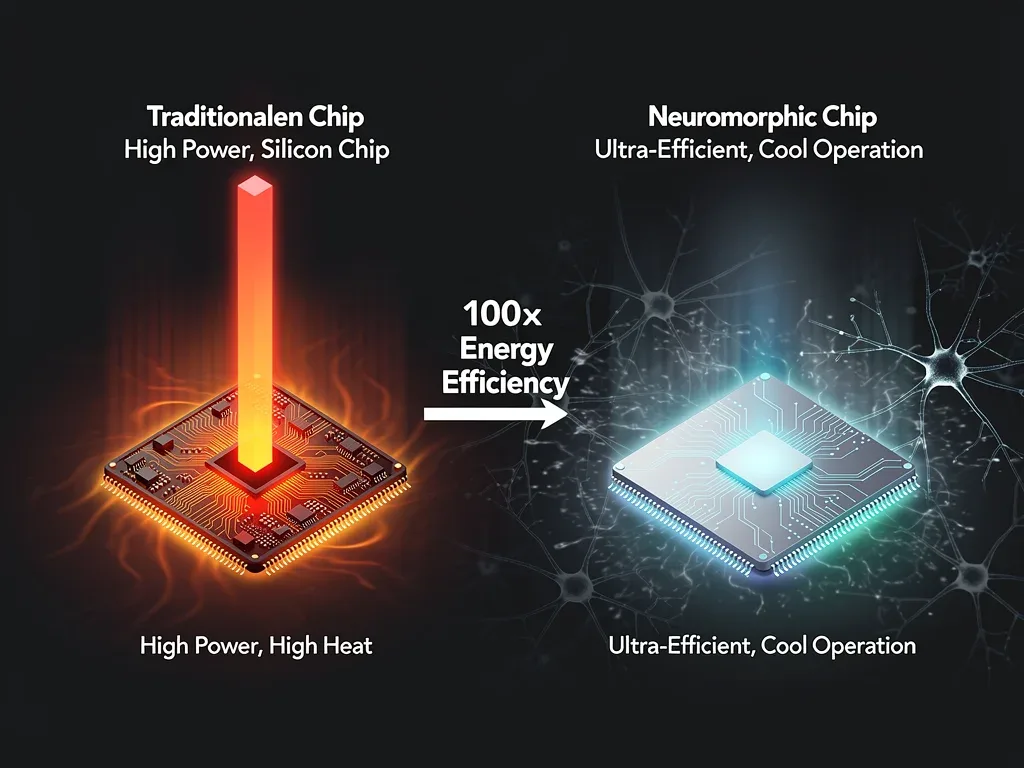
Neuromorphic computing platforms achieve a 100x energy efficiency leap over traditional silicon architectures by emulating the human brain's parallel processing and event-driven communication, critical for advanced AI applications.
The pursuit of artificial intelligence has long been constrained by the fundamental limitations of traditional computing architectures. As AI models grow in complexity, the energy demands of conventional silicon chips become increasingly unsustainable. This challenge has fueled intense research into alternative paradigms, with neuromorphic computing platforms: analyzing the 100x energy efficiency leap over traditional silicon architectures emerging as a frontrunner. This groundbreaking technology promises not just incremental improvements, but a radical transformation in how we process information, offering an unprecedented surge in energy efficiency that could redefine the future of AI and beyond.
Understanding the Energy Bottleneck in Traditional Silicon
Traditional silicon architectures, primarily based on the von Neumann model, have served as the bedrock of computing for decades. While incredibly powerful, their inherent design presents significant energy challenges, especially when tackling the demands of modern artificial intelligence and machine learning workloads. Understanding these limitations is crucial to appreciating the transformative potential of neuromorphic approaches.
The von Neumann architecture separates the processing unit from memory, leading to a constant shuttling of data back and forth. This 'memory wall' or 'von Neumann bottleneck' is a primary driver of energy consumption. Every data transfer requires power, and as AI models process vast amounts of data, these transfers become prohibitively expensive in terms of energy.
The Von Neumann Bottleneck Explained
The core issue lies in the sequential nature of data access and processing. CPUs and GPUs excel at rapid, complex computations, but their efficiency plummets when memory access becomes the limiting factor. This is particularly true for AI, which often involves:
- Massive Data Sets: Training large neural networks requires ingesting and processing terabytes of data.
- Repetitive Access: The same data points are often accessed multiple times during iterative learning processes.
- Data Movement Overhead: Moving data between memory and processor consumes substantial energy, often more than the computation itself.
Furthermore, traditional architectures are designed for general-purpose computing. While this versatility is a strength, it means they are not optimized for the specific, parallel, and sparse computations characteristic of neural networks. Their digital, synchronous operation also contributes to higher power dissipation compared to the event-driven, analog-like nature of biological brains. These factors combined create an energy bottleneck that limits the scalability and deployment of advanced AI, especially in power-constrained environments.
The Biological Inspiration: How Brains Achieve Efficiency
To truly grasp the energy efficiency leap offered by neuromorphic computing, we must look to its primary source of inspiration: the human brain. Nature's most complex processor operates with an astonishing level of efficiency, consuming merely 20 watts of power to perform tasks that would overwhelm even the most powerful supercomputers, which consume megawatts. This stark contrast highlights the fundamental differences in design principles.
The brain's efficiency stems from several key architectural and operational paradigms that diverge sharply from traditional computers. Unlike the digital, synchronous, and centralized processing of conventional silicon, the brain employs an analog, asynchronous, and highly distributed approach. Neurons, the brain's processing units, and synapses, its memory and communication links, are intimately intertwined.
Key Principles of Brain Efficiency
Several biological mechanisms contribute to the brain's remarkable energy performance:
- In-Memory Computing: Processing and memory are co-located. Synapses not only store information (memory) but also perform computations (processing) by modulating signal strength.
- Event-Driven (Spiking) Communication: Neurons communicate only when their activation threshold is met, sending discrete 'spikes' of information. This sparse, asynchronous communication means that not all parts of the network are active all the time, significantly reducing energy consumption.
- Massive Parallelism: Billions of neurons and trillions of synapses operate simultaneously, performing many simple computations in parallel rather than a few complex ones sequentially.
- Analog and Probabilistic Operations: Many biological processes are inherently analog and probabilistic, allowing for approximate computing that is often sufficient for real-world tasks and more energy-efficient than precise digital calculations.
By integrating memory and processing, and by adopting an event-driven communication model, the brain effectively bypasses the von Neumann bottleneck that plagues traditional architectures. This biological blueprint provides a compelling roadmap for designing a new generation of energy-efficient computing platforms.
Neuromorphic Architecture: Mimicking the Brain's Blueprint
Neuromorphic computing directly translates the brain's operational principles into hardware. These platforms are engineered to overcome the limitations of the von Neumann architecture by integrating processing and memory and adopting an event-driven communication paradigm. The goal is to create chips that are not just faster, but fundamentally more energy-efficient for AI workloads.
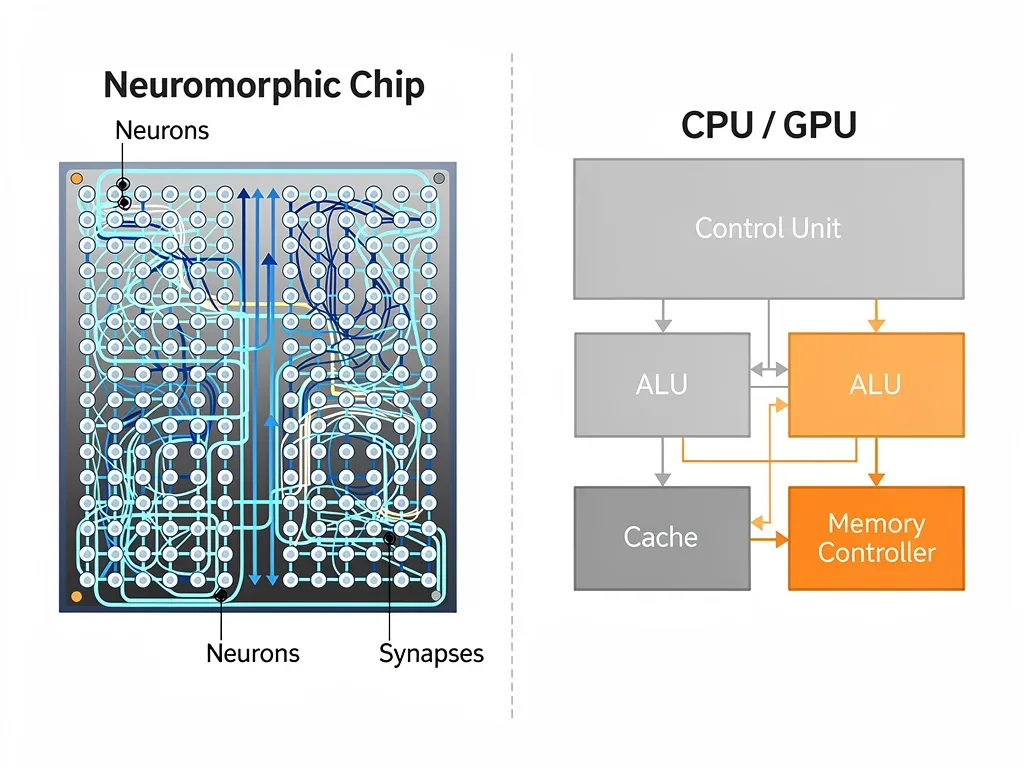
At its core, a neuromorphic chip consists of artificial neurons and synapses, often implemented as analog or mixed-signal circuits. These components are interconnected in a highly parallel fashion, allowing for localized processing where computation happens directly at the memory site. This eliminates the constant data movement that drains energy in traditional systems.
Key Architectural Features
The design of neuromorphic chips incorporates several innovative features:
- Spatially Distributed Memory and Processing: Unlike separate CPU/GPU and RAM, neuromorphic systems distribute memory elements (synapses) directly alongside processing units (neurons). This minimizes the distance data needs to travel.
- Spiking Neural Networks (SNNs): Many neuromorphic chips implement SNNs, which mimic the brain's event-driven communication. Neurons only 'fire' or 'spike' when necessary, leading to sparse and highly efficient data transmission.
- Asynchronous Operation: Components operate independently and asynchronously, rather than being synchronized by a global clock. This further reduces power consumption as inactive parts of the chip draw minimal power.
- Analog/Mixed-Signal Circuits: While some neuromorphic chips are fully digital, many leverage analog or mixed-signal components for greater energy efficiency in emulating biological neuron and synapse dynamics.
This radical departure from conventional design allows neuromorphic platforms to process information in a fundamentally different, and often more efficient, way for specific tasks. Instead of executing instructions sequentially, they react to events, processing data in parallel and only when relevant, leading to significant energy savings.
The 100x Energy Efficiency Leap: Mechanisms and Examples
The claim of a 100x energy efficiency leap is not hyperbole; it is rooted in the fundamental architectural differences and operational models of neuromorphic computing compared to traditional silicon. This dramatic improvement stems primarily from the elimination of the von Neumann bottleneck and the adoption of event-driven, in-memory computing.
Consider a traditional processor executing a neural network. Every weight and activation must be fetched from memory, moved to the processing unit, computed, and then potentially stored back. This constant data movement is the main energy sink. In contrast, a neuromorphic chip performs these operations where the data resides, significantly reducing the energy associated with data transfer.
Mechanisms Driving Superior Efficiency
- Reduced Data Movement: The most significant factor. By co-locating memory and processing, the energy-intensive process of moving data across a bus is drastically cut down.
- Sparse and Event-Driven Computation: In SNNs, only active neurons and synapses consume power. If a neuron doesn't receive enough input to spike, it remains quiescent, saving energy. This is particularly efficient for sparse data typical in sensory processing.
- Parallelism and Concurrency: Billions of operations can occur simultaneously across the chip, allowing for faster processing at lower clock speeds, which inherently reduces power consumption.
- Lower Precision Computing: Many neuromorphic systems can operate effectively with lower numerical precision than traditional digital systems, leading to simpler, more energy-efficient circuits.
Examples like IBM's TrueNorth chip, with its 1 million neurons and 256 million synapses, demonstrated power consumption in the tens of milliwatts while performing real-time pattern recognition. Intel's Loihi, another prominent example, has shown orders of magnitude improvements in energy efficiency for tasks like sparse coding and constraint satisfaction problems compared to conventional CPUs or GPUs. These early prototypes validate the potential for a 100x or even greater energy efficiency advantage, paving the way for AI at the edge and in embedded systems where power is a critical constraint.
Applications Revolutionized by Neuromorphic Efficiency
The profound energy efficiency of neuromorphic computing platforms opens doors to applications that were previously impractical or impossible with traditional silicon. By bringing powerful AI capabilities to power-constrained environments, neuromorphic chips are poised to revolutionize several key sectors, from edge devices to large-scale data centers.
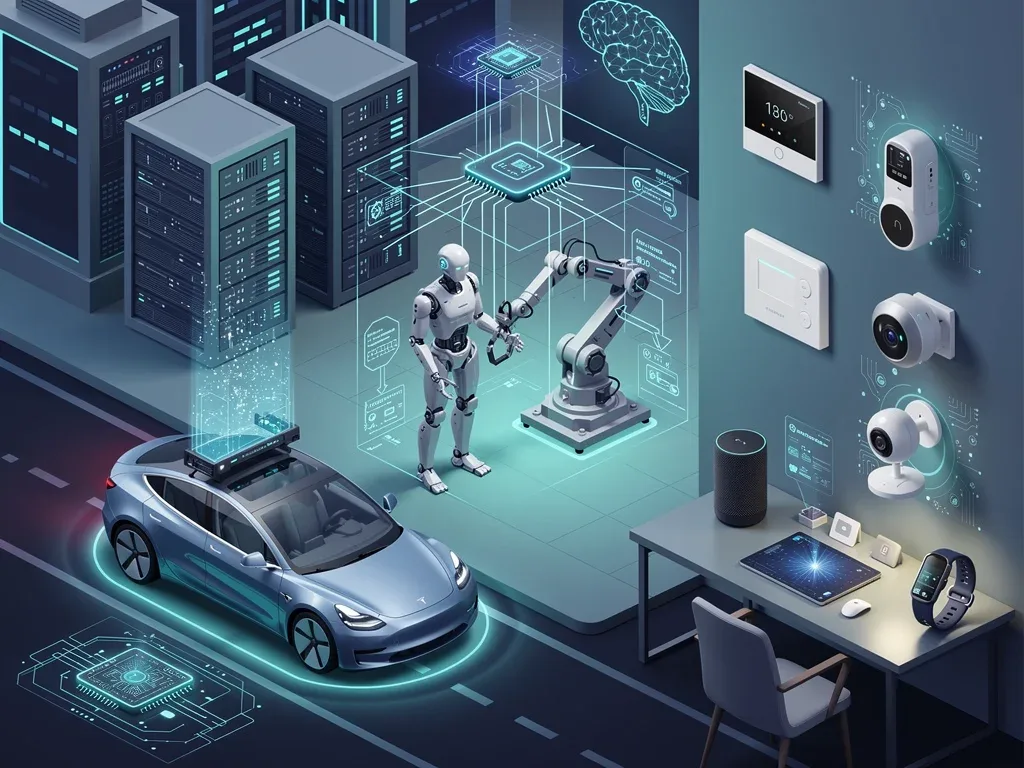
Imagine smart sensors that can process complex data on-site without needing to send everything to the cloud, or autonomous vehicles that can make split-second decisions with minimal power draw. These are just a few examples of how neuromorphic technology can transform our technological landscape by democratizing AI and making it ubiquitous.
Transformative Application Areas
- Edge AI and IoT Devices: Enabling complex AI tasks like voice recognition, gesture detection, and anomaly detection directly on small, battery-powered devices without cloud connectivity. This enhances privacy and reduces latency.
- Autonomous Systems (Vehicles, Drones, Robotics): Providing real-time, low-power processing for perception, navigation, and decision-making, crucial for safety and operational endurance.
- Medical Devices and Wearables: Integrating advanced analytics for continuous health monitoring, early disease detection, and personalized medicine, all while maintaining long battery life.
- High-Performance Computing and Data Centers: While primarily focused on edge, neuromorphic accelerators could also offload specific, highly parallel, and sparse AI workloads from traditional servers, leading to overall data center energy savings.
- Sensory Processing: Excelling at tasks involving continuous streams of sensory data, such as vision and auditory processing, due to their event-driven nature.
The ability to perform sophisticated AI computations with minimal energy consumption means that intelligent capabilities can be embedded into nearly every aspect of our lives, from smart homes to industrial automation. This efficiency leap is not just an incremental improvement; it's a paradigm shift that will enable a new generation of intelligent, always-on, and highly responsive systems.
Challenges and Future Outlook for Neuromorphic Computing
While the promise of neuromorphic computing is immense, its journey to widespread adoption is not without significant challenges. The technology is still in its nascent stages compared to the mature traditional silicon industry, and several hurdles need to be overcome before it can fully realize its potential and deliver on the 100x energy efficiency leap in commercial products.
One of the primary challenges lies in programming and developing algorithms for these novel architectures. Traditional software development tools and paradigms are not directly transferable, requiring new approaches and a different mindset from developers. Furthermore, the fabrication and scalability of neuromorphic hardware present their own set of engineering complexities.
Key Challenges Ahead
- Programming and Algorithm Development: Developing efficient algorithms and software tools for event-driven, spiking neural networks is a specialized field. The lack of standardized programming models and debugging tools hinders rapid development.
- Hardware Maturity and Manufacturing: Neuromorphic chips often involve novel materials and fabrication processes, making mass production challenging and potentially expensive. Ensuring reliability and yield at scale is crucial.
- Integration with Existing Systems: Seamlessly integrating neuromorphic accelerators into existing computing infrastructures (e.g., alongside CPUs/GPUs) requires robust interface standards and software stacks.
- Benchmarking and Performance Metrics: Traditional benchmarks often don't adequately capture the unique advantages of neuromorphic systems. Developing appropriate metrics to compare performance and efficiency fairly is essential.
- Hybrid Approaches: It is likely that the future will involve hybrid systems where neuromorphic chips excel at specific, energy-critical AI tasks, while traditional processors handle general-purpose computations.
Despite these challenges, the future outlook for neuromorphic computing remains incredibly bright. Major tech companies and research institutions are heavily investing in this field, pushing the boundaries of hardware design, software development, and application discovery. As research progresses and manufacturing techniques mature, neuromorphic platforms are expected to play an increasingly critical role in a world hungry for more efficient and intelligent computing. The 100x energy efficiency leap is not just a theoretical possibility but a tangible goal that could reshape the entire computing landscape.
| Key Point | Brief Description |
|---|---|
| Energy Efficiency Leap | Neuromorphic platforms offer up to 100x energy efficiency over traditional silicon, crucial for AI. |
| Brain-Inspired Design | Mimics brain's in-memory computing and event-driven communication to reduce data movement. |
| Key Applications | Revolutionizes edge AI, IoT, autonomous systems, and medical devices due to low power. |
| Future Challenges | Overcoming programming complexity, manufacturing hurdles, and integration issues is essential for adoption. |
Frequently Asked Questions About Neuromorphic Computing
What is neuromorphic computing?▼Neuromorphic computing is a technology that attempts to mimic the architecture and functionality of the human brain. It integrates memory and processing, uses event-driven communication (spiking neural networks), and operates with high parallelism, aiming for significantly greater energy efficiency than traditional computers, especially for AI workloads.
How does it achieve 100x energy efficiency?▼The 100x energy efficiency leap stems primarily from reducing the 'von Neumann bottleneck' by co-locating memory and processing. Additionally, event-driven (spiking) communication ensures that only active components consume power, leading to sparse and highly efficient computation. This minimizes energy-intensive data movement.
What are the main advantages over traditional silicon?▼Beyond superior energy efficiency, neuromorphic computing offers advantages in handling real-time, unstructured sensory data, learning on-device, and performing parallel computations. It's particularly well-suited for AI tasks that require pattern recognition, classification, and continuous learning with minimal power consumption.
Where will neuromorphic computing be most impactful?▼Its greatest impact is anticipated in edge AI devices, IoT sensors, autonomous systems (like self-driving cars and drones), and advanced robotics. These applications critically depend on low-power, real-time processing capabilities that traditional architectures struggle to provide efficiently.
What are the current challenges for this technology?▼Key challenges include developing new programming models and algorithms, overcoming hardware manufacturing complexities for scalable production, and integrating these novel systems with existing computing infrastructure. Standardizing benchmarks and fostering developer ecosystems are also crucial for wider adoption.
Conclusion
The advent of neuromorphic computing platforms represents a pivotal moment in the evolution of artificial intelligence and computing as a whole. By drawing inspiration from the unparalleled efficiency of the human brain, these innovative architectures are poised to deliver a transformative 100x energy efficiency leap over conventional silicon. This isn't merely an incremental improvement; it's a fundamental paradigm shift that promises to unlock new frontiers for AI, particularly in power-constrained environments like edge devices, autonomous systems, and advanced robotics. While significant challenges remain in terms of programming, manufacturing, and ecosystem development, the relentless pursuit of brain-inspired computing holds the key to a future where intelligence is ubiquitous, sustainable, and seamlessly integrated into our world.
